
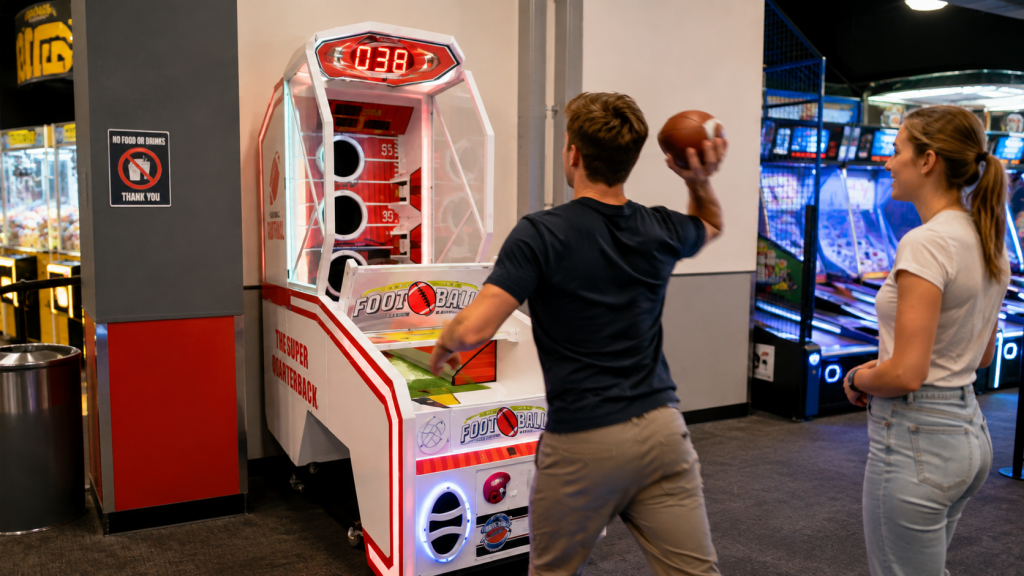
A football throwing arcade game has one advantage that is easy to overlook on a crowded game floor: most customers already understand the basic challenge before anyone explains it. Walk through a modern arcade and you may see VR headsets, racing simulators, shooting missions, redemption systems, and interactive screens competing for attention. Beside them, a simple physical challenge can communicate itself almost instantly.
Pick up the ball. Aim at the target. Throw. Check the score.
That simplicity may sound ordinary, but in a busy entertainment venue, being easy to understand can be a strength.
Why Physical Arcade Games Need Almost No Explanation
Customers rarely stop to study every machine before deciding what to play. They walk, look, compare, and make quick choices.
Some attractions offer deep experiences once the player understands the controls, but physical arcade games work differently. The action itself explains the objective. A visible target, a ball, and a scoring display are often enough for a new player to understand what is expected.
This can make physical games accessible to a broad mix of visitors. Families, teenagers, tourists, and adult groups do not necessarily need the same gaming experience or language skills to understand a familiar throwing challenge.
For operators, that makes this type of attraction useful in venues serving mixed audiences.
How a Sports Arcade Game Creates an Instant Challenge
A sports arcade game does not need to reproduce every rule of a real sport. Instead, it can reduce the activity to one recognizable skill.
Football throwing is a good example. The player does not need to understand formations, positions, or detailed match rules. The challenge becomes accuracy: aim at the scoring targets and collect as many points as possible during the available time.
That creates a physical experience without demanding athletic training.
It also introduces a different rhythm to an arcade dominated by seated or screen-based attractions. Instead of watching a monitor and operating buttons, the customer stands, aims, and performs the action directly.
Why a Football Skill Game Makes Scores Matter
The first attempt at a football skill game may simply come from curiosity. After that first round, however, the player has something they did not have before: a score.
That number becomes a reference point.
Can the next attempt be better? Can a friend beat it? Was the missed target caused by poor aim or bad timing?
Skill-based games naturally create these small comparisons because the player’s own performance becomes part of the challenge.
The game does not need a complicated storyline to create progression. A successful high-value throw provides immediate feedback, while a missed target gives the player an obvious reason to adjust on the next attempt.
This does not guarantee repeat play in every location, but it creates a natural structure for rematches and personal improvement.
A Football Throwing Arcade Game Is Easy to Watch
Some entertainment experiences are difficult to understand from outside the machine.
A VR player may be experiencing an exciting virtual world while spectators see only someone wearing a headset. A complex video game may require knowledge of the controls before a bystander understands whether the player is doing well.
Physical throwing games are different.
The entire action is visible. A spectator can see the player prepare, release the ball, watch the target, and react to the result. Even someone who has never played can immediately understand whether the attempt was successful.
That makes the activity relevant not only to the current player but also to friends waiting nearby.
In this type of game, the physical action itself becomes part of the entertainment.
Not Every Machine on the Arcade Floor Should Do the Same Job
It can be tempting to plan an arcade around the newest or most technologically advanced attractions. But a balanced game floor does not necessarily need every machine to deliver the same type of experience.
VR creates immersion. Racing simulators provide seated competition. Redemption machines introduce prize motivation. Shooting games create fast visual action.
A physical skill challenge contributes something different: standing movement, visible action, short rounds, and easy-to-understand competition.
This changes the question operators can ask when planning a venue.
Instead of only asking, “Which machine has the most features?” it may be more useful to ask, “What kind of activity is missing from my current game mix?”
If most attractions keep customers seated, a standing challenge can change the pace of the floor. If several games require longer sessions, a quicker physical challenge can offer another way to participate.
Where a Skill-Based Arcade Game Fits Naturally
This format can work well in family entertainment centers, traditional arcades, shopping mall game zones, bowling centers, sports-themed venues, and other indoor leisure locations.
The strongest fit is often a venue where customers arrive socially rather than individually.
Friends can compare scores. Parents and older children can take turns. Groups can rotate through attempts without learning different control systems.
Placement still matters. Operators should allow enough open space in front of the machine for natural throwing movement. The player should not interfere with a main walkway, and spectators should be able to watch without blocking nearby attractions.
Simple gameplay does not remove the need for thoughtful floor planning.
What Matters in a Commercial Arcade Machine
A straightforward game concept still depends on practical commercial design.
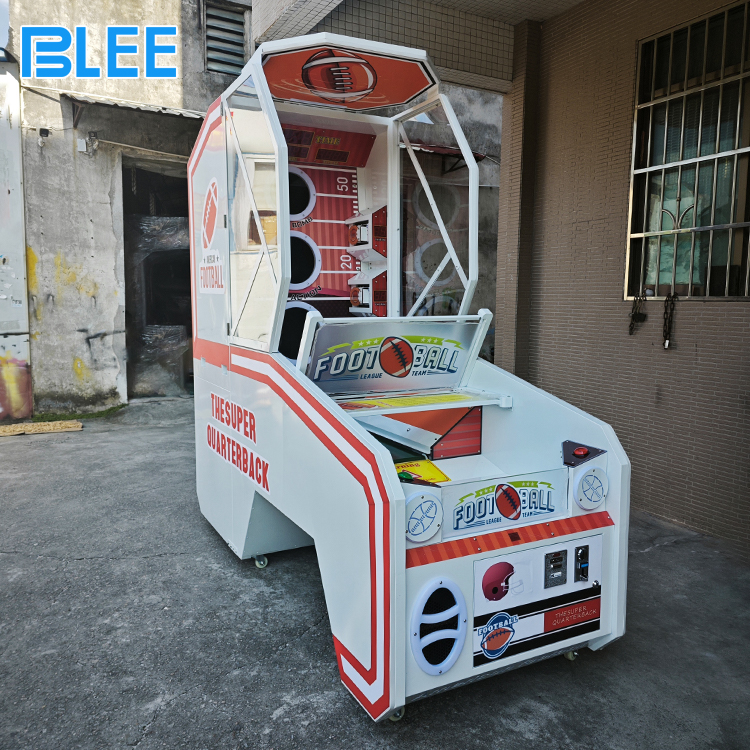
Target positions should be easy to identify. Scoring feedback should be clear. The ball return area should allow the next attempt to begin without unnecessary interruption. Cabinet stability and target durability also matter because repeated throwing creates different physical demands from a conventional video cabinet.
Operators should consider payment access, electronic scoring, maintenance convenience, overall dimensions, and the amount of clearance required around the machine.
Visual design plays a role as well. A recognizable sports theme can help customers identify the activity from a distance before they reach the cabinet.
BLEE’s coin-operated football model follows this physical skill-game format with multiple scoring targets, electronic score feedback, straightforward coin operation, and a recognizable American football theme.
As arcades add more screens, headsets, simulators, and interactive technologies, not every attraction needs to become more complicated. Sometimes a football throwing arcade game earns its place for the opposite reason: customers see it, understand it, and already know what they want to try before they have even stopped walking.