
A motion VR racing simulator has to do something unusual: create a convincing private experience for the driver while still making sense to everyone standing outside the headset. That tension matters more in an arcade than it does at home, because commercial entertainment does not happen only between a player and a screen. It happens in a room full of friends, spectators, waiting customers, and people deciding what they want to try next.
That is why the most interesting racing attractions are not necessarily the ones with the most technology. They are the ones that connect what the player feels with what the surrounding crowd can see.
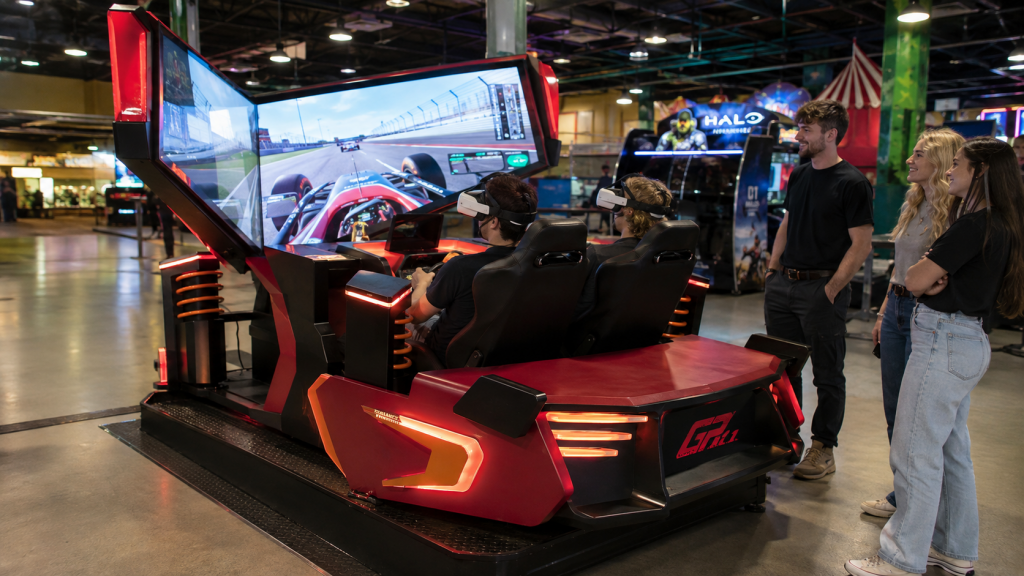
Inside the Headset, the Race Feels Completely Different
VR changes racing because the player no longer watches the track from a distance. The track surrounds them.
Corners feel closer, speed feels more immediate, and the driver’s attention is pulled into the virtual environment rather than toward a flat display in front of the seat. When the headset is combined with steering input and physical movement, the experience becomes less like watching a racing game and more like participating in one.
But that strength also creates a problem.
The better the headset isolates the player, the less obvious the experience may become to everyone else. A person walking past an arcade may simply see someone wearing a headset and moving in a seat. Without additional visual information, it can be difficult to understand what is happening inside the game.
For a home user, that may not matter. For a commercial arcade, it does.
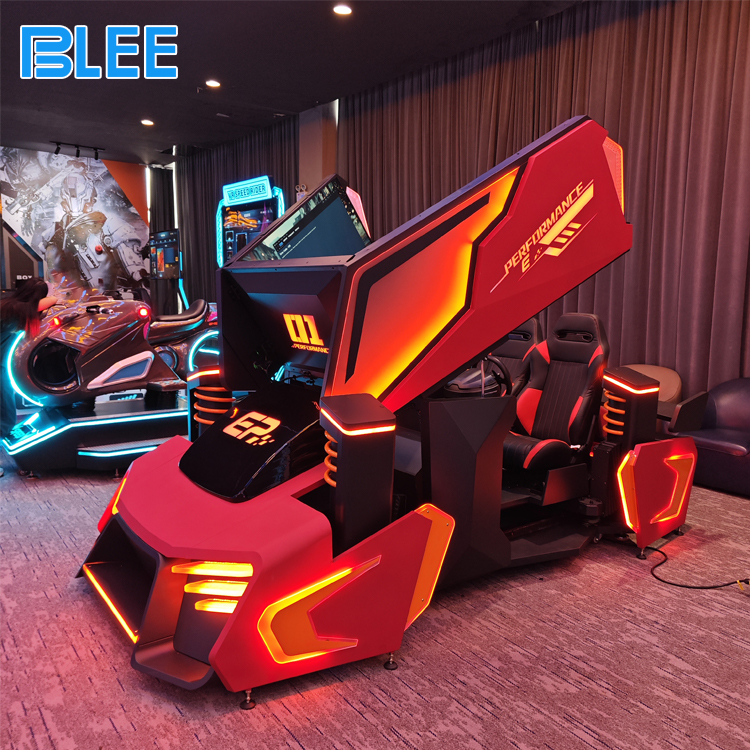
How Spectator Screens Improve a Two-Player VR Racing Simulator
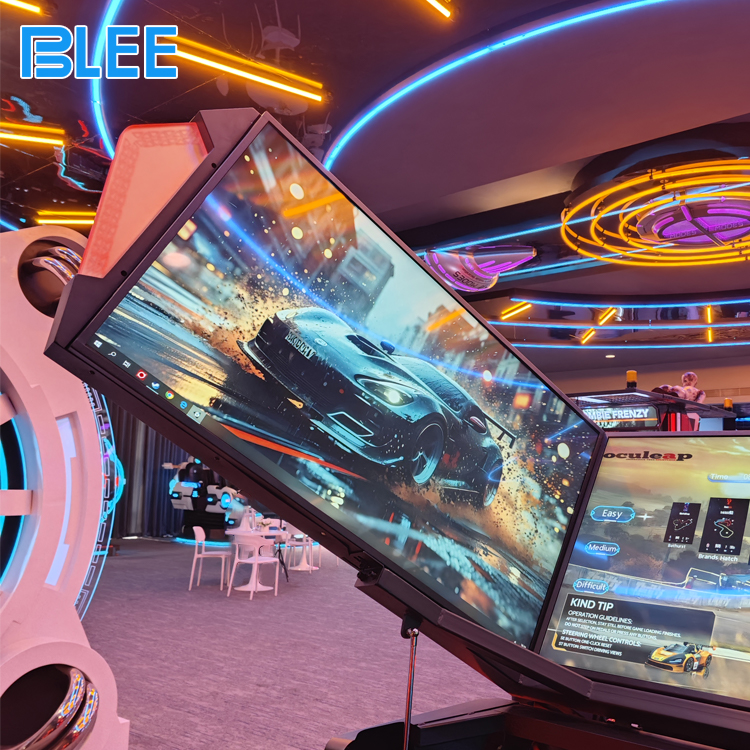
A large external screen changes the way a VR driving simulator works on the arcade floor.
The player still receives the immersive view through the headset, but friends and nearby customers can follow the race from outside. They can see the track, understand the competition, watch overtakes, and react to mistakes or close finishes.
That screen is not simply an extra display for decoration. It gives private VR gameplay a public layer.
This matters particularly when two people are racing at the same time. Instead of seeing two players sitting inside equipment with no context, spectators can understand who is ahead, what kind of track they are driving, and why the players are reacting.
The experience becomes easier to watch before someone decides to play.
Why a Motion VR Racing Simulator Needs More Than Immersion
Visual immersion alone cannot reproduce every part of driving.
Acceleration, braking, changes in direction, and sudden movement all create physical expectations. When the racing seat or cockpit responds to events in the game, the body begins receiving information that supports what the eyes are seeing.
This motion does not need to imitate every movement of a real vehicle perfectly. Its value comes from reinforcing key moments in the race.
A turn can feel more significant when the seat responds. A change in speed can feel stronger when the platform moves with the action. Combined with the headset, this physical feedback helps the arcade racing simulator create a more complete sense of movement.
Motion also has another commercial advantage: it is visible.
Someone passing nearby may not know exactly what the driver sees, but they can immediately recognize that the equipment is reacting to the game. The attraction communicates some of its value before the customer has even put on the headset.
Two Seats Change More Than Player Capacity
Adding a second seat does not simply double the number of players.
It changes the social rhythm of the experience.
Two friends can race at the same time instead of taking turns. One finish immediately creates a comparison. Who was faster? Who made the mistake? Who wants a rematch?
That natural competition can be particularly useful in venues where customers arrive in pairs or groups.
Friends, couples, colleagues, and family members often choose entertainment together. A two-player VR racing simulator gives them a shared activity while still preserving the intensity of an individual driving experience.
The spectator screen extends that interaction further. A group of four people does not necessarily divide into “two playing and two waiting.” The people outside the machine can still follow the race and become part of the moment.
That is a very different atmosphere from a completely isolated VR experience.
How a Commercial Racing Simulator Works Between Games
Arcade equipment spends a surprising amount of time being observed rather than actively used.
Customers walk past it. They look at the screen. They watch other people play. They decide whether the experience appears interesting enough to spend time and money on.
That means a commercial racing simulator has two jobs.
The first is obvious: deliver a good experience once the player sits down.
The second is less obvious: communicate that experience to someone who has not played yet.
Cabinet design, visible screens, physical movement, lighting, seating layout, and location inside the venue all contribute to that second job.
A machine positioned where customers can see both the screen and the moving cockpit may have a very different presence from the same equipment placed in a hidden corner.
This is why floor planning still matters even when the machine itself is visually impressive.
Where This Racing Experience Makes the Most Sense
A large two-seat racing attraction needs more consideration than a compact upright arcade cabinet.
Operators should think beyond the footprint of the machine itself. Players need room to enter and leave the seats comfortably. Spectators need enough distance to watch without blocking the main walkway. Staff also need access for cleaning, inspection, and routine maintenance.
The format can work particularly well in arcade centers, family entertainment centers, shopping mall game zones, indoor amusement venues, and leisure destinations where customers often arrive with friends.
It can also complement other attractions.
A venue with shooting games, motion rides, redemption equipment, or other competitive machines can use racing as a different form of shared play. The objective is not necessarily to fill the floor with similar simulators, but to create a mix of experiences that encourage different types of interaction.
Designing a Motion VR Racing Simulator for Drivers and Spectators
BLEE’s dual-seat F1-style racing equipment combines VR headsets, an audience-facing display, a two-player cockpit, and a dynamic motion platform within one commercial attraction. The purpose of that combination is not simply to add more features to a racing cabinet.
Each element serves a different person.
The headset serves the driver.
The moving platform reinforces the physical experience.
The second seat creates direct competition.
The large screen gives everyone outside the cockpit a reason to follow what is happening.
For operators evaluating racing equipment, that distinction is worth considering. A machine does not exist in isolation once it enters a real arcade. It becomes part of the surrounding crowd, the venue layout, and the social experience of the people who came together.
A well-planned motion VR racing simulator therefore has to succeed in two places at once: inside the headset, where the race feels personal, and outside it, where the experience becomes part of the arcade itself.