
An interactive footstep arcade game can attract attention before a player fully understands the rules. In a busy arcade, people rarely stop to study long instructions. They usually make a much faster decision: does the game look easy to understand, does the action feel interesting, and can I start playing almost immediately?
This is why simple physical interaction still has a strong place in modern entertainment venues. A machine does not always need complicated controls to create an engaging experience. Sometimes, a clear action and an immediate response are enough to make people curious.
The Three-Second Learning Curve in Modern Arcades
Arcade players are surrounded by screens, lights, sounds, and competing attractions. That means a machine often has only a few seconds to communicate how it works. If the basic interaction is difficult to understand from the outside, some customers may simply keep walking.
A stepping game machine reduces that barrier by making the main action visible. Players can quickly see where to stand, what movement is required, and how their actions affect the game. The control method becomes part of the attraction rather than something that needs to be explained separately.
This type of simplicity can be especially useful in family entertainment centers, shopping mall arcades, and other venues where players have different ages and levels of gaming experience.
Why a Foot-Controlled Arcade Game Feels More Immediate
Traditional arcade controls often rely on buttons, joysticks, or handheld controllers. A foot-controlled arcade game changes the relationship between the player and the machine by turning body movement into the primary input.
Instead of only moving their hands, players step, shift their weight, and react physically to what they see on the screen. The connection between movement and visual feedback feels direct, which helps make the experience easier to understand.
There is also less separation between “learning the controls” and “starting the game.” Once the player understands that stepping is the main action, the basic interaction becomes relatively intuitive.
Physical Arcade Games Are Easier to Understand From a Distance
A physical arcade game also communicates differently to spectators. Someone watching a joystick game from several meters away may not immediately understand what the player is doing. Larger body movements are easier to notice.
When a player steps quickly, changes position, or reacts to a screen challenge, nearby visitors can often understand the basic concept without reading instructions. This creates a useful visual effect on the arcade floor: one player is playing, while other people are already learning how the machine works simply by watching.
That visibility can make physical interaction valuable even before the next customer begins a game.
Why a Single-Player Arcade Game Keeps Entry Simple
Multiplayer equipment can create strong social experiences, but there are also situations where a single-player arcade game has an advantage. A customer does not need to wait for a friend, find another participant, or coordinate with someone else before beginning.
This makes the decision to try the machine more independent. A player can walk up, understand the basic action, and start on their own. In locations with constantly changing visitor traffic, that low entry barrier can be useful.
Single-player equipment can also work well as part of a mixed arcade lineup, giving visitors a quick physical challenge between larger group or multiplayer experiences.
Where an Interactive Footstep Arcade Game Fits
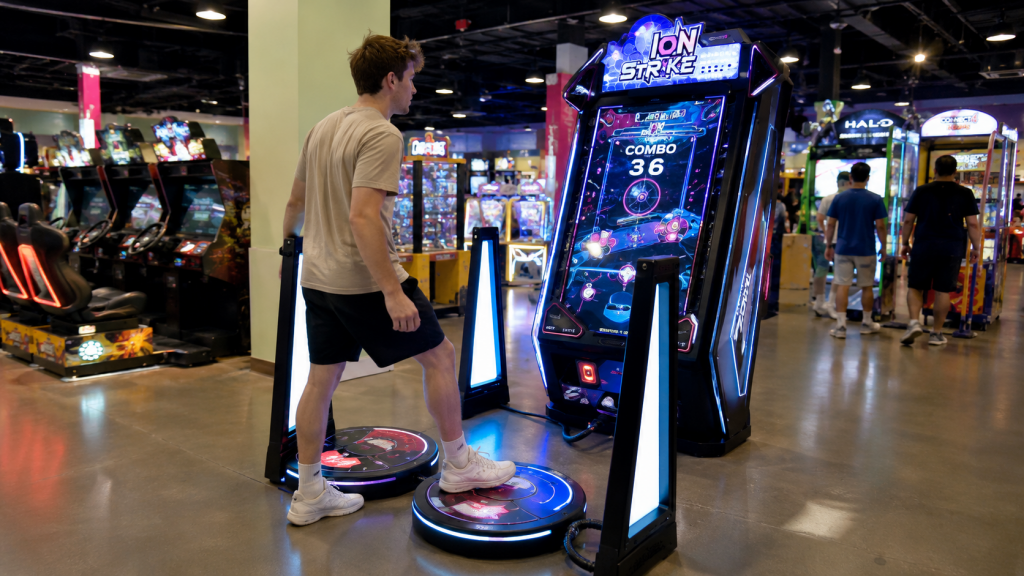
BLEE Ion Strike shows how this type of interaction can be translated into a commercial arcade format. The machine combines a vertical game display with dedicated footstep control areas, creating a single-player experience centered on stepping, reaction, and screen feedback.
Rather than depending on a complicated control panel, the basic interaction is visible from the outside. That helps the machine fit naturally into the type of quick-learning environment described above.
Ion Strike can therefore be viewed less as a traditional button-based game and more as a compact physical challenge where the player’s movement becomes part of the entertainment. This distinction can help diversify an arcade floor that already contains racing, shooting, redemption, or joystick-based games.
What Operators Should Look for in a Reaction Game Machine
When evaluating a reaction game machine, operators should look beyond screen graphics alone. The relationship between the player, the control method, and the surrounding space can be just as important.
Questions worth considering include how quickly new players understand the activity, whether the required movements are visible to spectators, how much space is needed around the machine, and whether players can enter and leave the game area comfortably.
The ideal machine should also complement the rest of the venue. A motion-based attraction can add a different type of activity to an arcade dominated by seated simulators or hand-controlled machines.
Simple Motion Arcade Games Can Still Create Strong Engagement
Physical interaction does not have to be complicated to feel satisfying. A motion arcade game can create engagement through a simple loop: see the challenge, move, receive immediate feedback, and try again.
That clarity is part of the appeal. Players can focus on improving their timing and reactions instead of remembering a complicated control system. At the same time, visible body movement gives nearby visitors a clear idea of what is happening.
For operators, this is a useful reminder that arcade attraction is not only about bigger screens or more buttons. Ease of understanding, physical participation, and visible gameplay can all influence whether someone decides to stop and play.
When these elements work together, an interactive footstep arcade game can turn a very simple action—taking a step at the right moment—into an experience that is easy to approach, easy to watch, and difficult to ignore.