
A VR off-road simulator can feel convincing for a reason that has little to do with top speed. Rough terrain naturally creates changes in pitch, vibration, direction, and body movement, giving a motion platform more opportunities to respond to what the player sees on screen.
In conventional driving games, the road may remain relatively smooth for long periods. Off-road environments behave differently. Hills, uneven surfaces, obstacles, sudden drops, and sharp changes in direction constantly alter the vehicle’s movement. When visual information and physical feedback work together, these changes can make the experience feel more active and less predictable.
Why Rough Terrain Creates Stronger Physical Feedback
A smooth racing circuit is designed for speed and control. Off-road terrain is almost the opposite. The surface itself becomes part of the challenge.
A vehicle may climb a slope, lean to one side, drop after crossing an obstacle, or move over a sequence of uneven sections. These movements give a motion platform clear events to reproduce. Instead of maintaining one steady driving sensation, the system can continually change the player’s physical position.
This is one reason an off-road VR ride can feel energetic even when the virtual vehicle is not moving at extreme speed. The player is reacting not only to direction and acceleration, but also to the changing surface beneath the vehicle.
A Motion VR Simulator Needs More Than Speed
Speed is one of the easiest sensations to communicate visually. Objects move past the player faster, the road narrows into the distance, and the environment creates a strong impression of forward motion.
But visual speed alone does not always create physical immersion.
A motion VR simulator becomes more convincing when the player’s body receives feedback that supports what the eyes are seeing. If the virtual vehicle climbs sharply while the seat remains completely level, part of the illusion can disappear. The same is true when the screen shows a heavy impact or rough landing without any corresponding movement.
Good synchronization matters more than simply making the platform move as much as possible. The motion should make sense in relation to the terrain, steering, and vehicle behavior.For a VR off-road simulator, this synchronization is especially important because changing terrain creates frequent shifts in movement, vibration, and direction.
Why an Off-Road VR Ride Feels Different From Racing
Racing games and off-road experiences can both use driving controls, but they create different types of excitement.
Traditional racing often focuses on lap times, overtaking, cornering, acceleration, and competition. The road is usually structured around maintaining speed and finding the best driving line.
Off-road experiences introduce another variable: the terrain itself.
A slope can change the player’s view. An obstacle can interrupt forward movement. A rough section can create repeated vibration. A sudden descent can produce a short moment of anticipation before the vehicle reaches the bottom.
These elements make the environment feel less like a background and more like an active part of the game.
For an arcade operator, this difference can also help diversify a VR area. A venue that already has traditional racing simulators can add a different type of driving experience without simply repeating the same gameplay in another cabinet.
Vehicle Design Can Shape Expectations Before the Game Starts
Immersion does not begin only after the player puts on a headset.
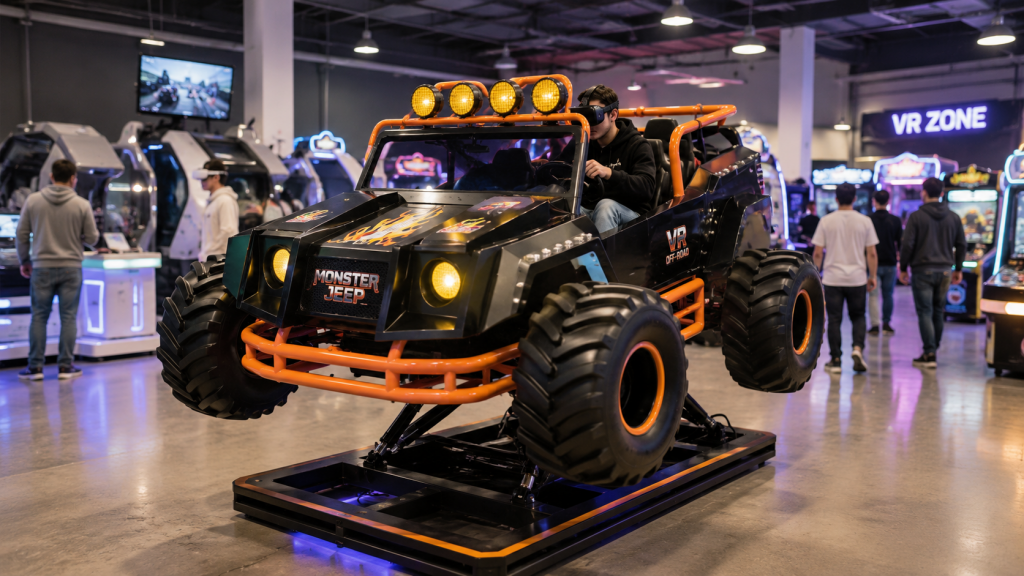
The physical appearance of an attraction can tell visitors what kind of experience they are about to have. A large vehicle body, oversized tires, protective frame, and off-road styling immediately communicate a different message from a Formula-style racing seat.
This matters in busy entertainment venues where people often judge attractions from several meters away.
A monster truck simulator can visually suggest heavy movement, rough terrain, and adventure before the player knows anything about the specific game content. That makes the exterior part of the attraction’s communication.
For spectators, the vehicle shape can also make the experience easier to understand. They do not need to read a long explanation to recognize that the attraction is built around off-road driving rather than conventional track racing.
Where a VR Off-Road Simulator Fits
BLEE Extreme VR Off-Road brings these ideas together through a monster-truck-inspired vehicle structure, VR content, and motion feedback designed around driving over changing terrain.
Rather than treating the vehicle body as decoration alone, the large off-road form helps establish the theme before the experience begins. Once inside, the visual environment and platform movement can work together to represent climbing, turning, uneven surfaces, and other driving events.
This makes the attraction different from a standard seated VR experience where the player remains relatively still.
It can also work as part of a mixed VR zone alongside racing, shooting, flying, or other motion-based attractions. Each category offers a different type of physical participation, giving visitors more reasons to try multiple experiences within the same venue.
What Operators Should Consider Beyond the Vehicle Design
A dramatic appearance can attract attention, but operators should also evaluate how an immersive VR attraction works in everyday operation.
One important factor is the relationship between motion and content. Movement should support the virtual terrain rather than feel random or disconnected.
Space is another consideration. Large vehicle-style attractions need sufficient room for player access, operator assistance, and safe circulation around the equipment.
Operators should also consider how easily customers understand the experience from the outside. A visually distinctive vehicle can help, but the overall attraction should still communicate its basic concept quickly.
The surrounding game mix matters as well. If an arcade already contains several conventional racing machines, a different form of physical driving can create more variety than adding another similar racing seat.
Motion Feedback Should Support the Story of the Terrain
A VR motion ride works best when physical movement contributes to what the player believes is happening.
When the virtual vehicle climbs, the body can feel a change in angle. When the road becomes rough, smaller repeated movements can reinforce the surface. When the vehicle turns or drops, the motion can help the player anticipate and understand the event.
These responses do not need to be exaggerated every second. Constant strong movement can become tiring and may actually reduce the contrast between important moments.
Variation is more useful. Calm sections make rough terrain feel rougher. Stable movement makes a sudden drop more noticeable. The physical experience becomes more readable when different types of terrain produce different sensations.
This is where off-road content has a natural advantage: the environment already provides frequent reasons for motion to change.
Terrain Can Become Part of the Attraction
The most memorable driving experiences are not always the fastest. Sometimes the changing relationship between the vehicle, the surface, and the player’s body creates a stronger sense of participation.
For operators, that means evaluating more than graphics or vehicle appearance. The question is whether the content, motion system, physical design, and surrounding space work together as one experience.
A well-designed VR off-road simulator turns rough terrain from simple scenery into an active part of the ride, giving players something they can see, anticipate, and physically feel.