A self-service token dispenser is the first machine a customer meets in most arcades. If it is slow, out of tokens, or unclear about what it accepts, the queue forms before anyone reaches a game. This guide covers the numbers that decide whether a token kiosk keeps up with a venue.
What a self-service token dispenser has to solve
Payment in an arcade splits into two jobs. One is taking money; the other is turning that money into something the games accept. A token dispenser handles the second job, and it has to do it in seconds, in public, without staff.
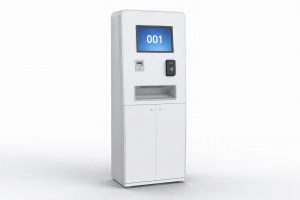
The self-service token dispenser in this range is a double-door kiosk built for that single purpose. It stands 155 cm tall and uses a steel body, so it can sit in a lobby without looking like an afterthought next to the cabinets.
Capacity planning for a self-service token dispenser
The hopper holds up to 15,000 tokens. That figure matters less on opening day than on your busiest Saturday, when a refill cannot wait for a quiet moment.
| Planning item | Figure | What it changes |
|---|---|---|
| Hopper capacity | up to 15,000 tokens | Refill interval on peak days |
| Cabinet footprint | W55 × D42 cm | Floor space and queue room |
| Height | 155 cm | Signage position and reach |
| Weight | 60 kg | Delivery route and floor loading |
| Power draw | 28–43 W | Circuit planning is almost trivial |
A 15,000-token hopper is generous for a single floor, but not endless. Work out your peak-day token outflow before you decide the refill schedule, then add a buffer for events and school holidays.
Three payment modes on the self-service token dispenser
The distinguishing feature of this self-service token dispenser is a three-way payment system. It accepts online payments, cash, and coin input in the same cabinet.
That combination solves a practical problem. Venues that go cashless lose the walk-in customer who arrives with notes in a pocket. Venues that stay cash-only lose the customer who keeps card details on a phone. A kiosk that takes all three avoids the choice.
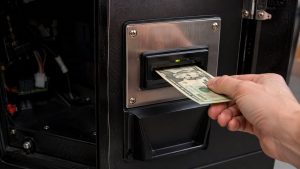
Two honest limits are worth stating. The base model does not include a banknote validator, and it does not include a multi-currency coin acceptor. Both are available as upgrades at extra cost. If your market runs on notes, price the validator into the project from the start rather than discovering the gap after delivery.
Voltage and power on the self-service token dispenser
The kiosk accepts 100 V to 250 V, and draws between 28 W and 43 W. For an operator, that means one specification covers the United States, the European Union and most of Asia without a transformer. The load is small enough that it will not force a circuit redesign.
Keep it on its own outlet anyway. A token dispenser that shares a circuit with a bank of cabinets is a token dispenser that reboots when the floor peaks.
Placement and queue design for the token dispenser
Put a self-service token dispenser where a customer arrives, not where they leave. In practice that means the entrance lobby, facing the door, at a height where the digital display is readable from two metres back.
Leave room for a queue that forms sideways rather than backwards. A self-service token dispenser against a wall with no lateral space turns a three-person queue into a corridor blockage.
The double-door layout also helps operationally. Staff can service the hopper from the rear without walking around the front and disturbing the queue.
What to check before ordering a self-service token dispenser
Four items decide whether the specification fits your venue. Confirm each in writing rather than assuming the default.
First, the payment configuration: validator and coin acceptor included or not. Second, the display language, since this self-service token dispenser ships with English text. Third, the lead time. Stock ships in four to seven working days, while production takes twelve to thirty. Fourth, the shipping mode, because sea freight, air freight and express courier change both the cost and the arrival date.
Frequently asked questions
How many tokens should a venue keep in the hopper?
The hopper on a self-service token dispenser takes up to 15,000 tokens. Fill it before opening, and top up at the quietest hour rather than waiting for a queue.
Does the base model accept banknotes?
No. A banknote validator is an optional upgrade, as is a multi-currency coin acceptor. Specify both if your market pays with notes.
Can it run on 110 V and 220 V?
Yes. The self-service token dispenser accepts 100 V to 250 V, so one specification covers most export markets.
Where should the kiosk sit?
In the entrance lobby, facing the door, with lateral space for a sideways queue and rear access for staff refills.
For the full specification and upgrade options, see the BLEE self-service token dispenser product page. For wider guidance on running an attractions venue, IAAPA resources cover operations and safety topics.