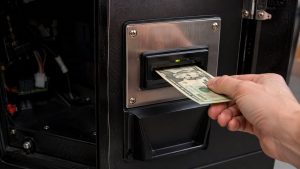
An arcade bill acceptor is the part of your machine that decides whether a customer can pay at all. When it rejects a valid note, the sale is lost and the player walks to the next cabinet. That is why the specification matters more than the price tag. This guide covers what to compare before you order.
Most operators buy an arcade bill acceptor once and then forget it. That works until a currency update arrives, a stacker jams, or a customer folds a note the wrong way. A careful choice up front prevents all three problems.
What an arcade bill acceptor actually does
A bill acceptor does three jobs in sequence. It reads the note, it decides whether the note is genuine, and it moves the note into a secure stacker. Each job has its own failure mode, and each one shows up differently at the machine.
Reading is optical. Sensors scan both sides of the note and compare the pattern against stored validation data. Validation is the decision step. A good unit checks the note against several parameters instead of one. Transport is mechanical, and this is where most field faults appear, because dust, bent corners, and worn belts all interfere with the path.
When you compare an arcade bill acceptor across suppliers, compare these three layers separately. A cheap unit usually saves money on the transport mechanism, not on the optics.
Which specifications matter most
Start with the notes you need to accept. Currency coverage is not universal, and a unit built for one market may reject the notes your customers actually carry.
- Accepted denominations. Confirm the exact notes, including the newest series in circulation.
- Insertion directions. Four-way insertion reduces friction at the machine, because players rarely check the orientation.
- Validation time. A short cycle keeps the queue moving. Three seconds including stacking is a practical benchmark.
- Stacker capacity. Match it to your collection interval, not to the maximum available.
- Interface. Check whether the unit offers a standard connector for program updates.
- Mounting. Confirm the plate, hardware, and power lead are included, or budget for them.
Write these numbers into your purchase order. A supplier who cannot state them in writing cannot be held to them later.
How to avoid the most common failures
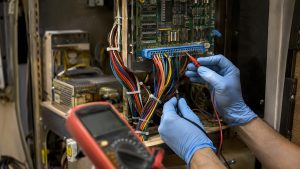
Most bill acceptor complaints trace back to installation and environment rather than to the electronics.
Keep the machine level and away from direct heat. Dust is the main enemy of the transport path, so schedule a cleaning interval that matches your venue. On a busy floor, that may be weekly. In a quiet site, monthly is often enough.
Train staff to open the bill path correctly. A unit that opens with two buttons and no tools is easier to clear and less likely to be damaged during a jam. That single design detail saves more service calls than any specification on the datasheet.
Finally, keep the validation data current. Currency designs change, and an outdated unit will start rejecting notes that used to pass. Ask how updates are delivered before you buy, and confirm the connector type.
When to repair and when to replace
Repair makes sense when the fault is mechanical and the parts are available. A worn belt, a jammed stacker, or a dirty sensor is a maintenance job.
Replace the unit when it fails repeatedly on the same note type, when spare parts are no longer supplied, or when the validation data cannot be updated. At that point the unit has become a bottleneck, and the cost of downtime exceeds the cost of a new part.
Keep one spare on the shelf for each model you run. A spare arcade bill acceptor turns a lost weekend into a fifteen-minute swap.
How to compare two quotes
Put both quotes on the same page and compare four lines: accepted denominations, validation time, stacker capacity, and what is included in the box. Then add the cost of spares and the update path.
A quote that is lower on the unit price often omits the mounting kit or the power lead. Once those are added, the difference frequently disappears.
For a ready reference point, look at the ICT A6 bill acceptor we supply. It accepts US one, five, ten, and twenty dollar notes, validates in about three seconds including stacking, and opens the bill path with two buttons. Use its specification sheet as a checklist when you compare other models.
Frequently asked questions
Does a bill acceptor work with any arcade cabinet?
Mechanically, most units fit a standard cut-out, but the interface and power supply differ. Confirm the connector and voltage before ordering.
Why does my machine reject notes that are not torn?
Dirty sensors and outdated validation data explain most rejections. Clean the optics first, then check whether an update is available.
Can I update the accepted notes myself?
Many units allow a program update through a standard connector. Ask the supplier for the procedure and the file format before you commit.
Is a higher price always a better unit?
No. Compare the transport mechanism, the stacker, and the update path. Those three decide how the unit behaves after a year on the floor.
If you are specifying a fleet, treat the vending machine payment chain as one system. The acceptor, the coin mechanism, and the controller all need to agree on the interface.