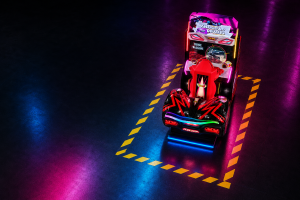
Arcade racing machine placement decides more of your revenue than the cabinet you choose. A perfect simulator in a dead corner earns nothing. The same unit on a sightline from the entrance pays for itself. This guide sets out the measurements, the power arithmetic and the traffic rules that decide the spot.
TL;DR
- Measure the bay, not the machine: length + 1 m in front + 1 m behind.
- Put racers where people walk past them, not where they walk into them.
- One 150 W cabinet is about 1.25 A at 120 V. Nine fit a 15 A circuit at 80% load.
- Give the cabinet a wall. An island loses its back and its cable route.
- Level the floor and bolt the plinth before the first coin drops.
1. Measure the Bay Before You Measure Anything Else
A racing cabinet does not occupy its own footprint. It occupies its footprint plus the space a player needs to climb in and the space a bystander needs to stand.
BLEE quotes one metre behind the seat for entry and one metre in front for clear viewing on its car-body racing simulator. Treat those as minimums, not targets.
The bay formula is simple:
Bay depth = cabinet length + 1.0 m front + 1.0 m behind
Bay width = cabinet width + 0.3 m service gap
Take a cabinet that measures 2.0 m long and 1.2 m wide. The bay is 4.0 m deep and 1.5 m wide, which is 6.0 m². Add a share of the aisle at 1.5 m by 1.2 m and you are budgeting around 7 m² of floor for one sit-down racer.
Measure your actual cabinet, not the example. Crate dimensions on the order confirmation give you the outer limits, and the cabinet is smaller than its crate.
2. Arcade Racing Machine Placement Starts at the Entrance
Stand at your front door and look in. Whatever you see first sets the tone of the venue. Whatever sits just off that sightline gets walked past on every visit.
Racers belong on that path, not on it. The distinction matters because a seated player blocks circulation for three to five minutes at a time.
Put the cabinet where the sightline catches it but the queue does not. A side wall facing the entrance works well. A turn in the aisle works better, because a player waiting to sit is already out of the walking line.
Avoid these three positions:
- Directly inside the door, where a seated player becomes an obstacle in the first metre of the venue.
- At the end of a dead-end aisle, where nobody passes and nobody queues.
- Behind a pillar or a prize counter, where the lit cabinet is visible only from one angle.
3. Sightlines: Screen Height Decides the Spot
Sightlines decide arcade racing machine placement as much as aesthetics do. A seated racing player looks up at the screen, not across at it, and that geometry changes where the machine should stand.
If the screen faces a bright window, the player sees reflection instead of track. If the screen faces a blank wall at close range, the immersion collapses. If the cabinet faces a wall at two to three metres, the player has depth behind the screen and the image reads better.
For a car-body simulator with a tall tower, the screen sits well above a standing adult’s eye level. Place it so the screen back is not against a glass frontage. Watch the sun path at the hour your venue is busiest, then decide which way the cockpit faces.
4. Give the Machine a Wall, Not an Island
An island looks generous in a floor plan and fails in operation. It is the most common arcade racing machine placement mistake in a new venue. A freestanding racer shows its back panel to half the room, loses a cable route, and collects clutter behind the seat.
A wall position solves all three:
- The rear panel is hidden, so the visible face is the lit cockpit.
- Cables run along the skirting instead of across the floor.
- The one metre behind the seat becomes a corner nobody walks through.
If you must use an island, put a low planter or a prize plinth behind it so the service side is protected.
5. Power: Count Amps Before You Count Machines
Power is the part of arcade racing machine placement that most operators skip. The published figure for the BLEE car-body racing simulator is 150 W. That covers the screen, the light bars and the floor glow.
Convert it to current before you plan the circuit:
- 150 W ÷ 120 V = 1.25 A per cabinet
- 150 W ÷ 230 V = 0.65 A per cabinet
Then apply the 80% rule that electrical codes use for continuous loads, because an arcade runs all day:
| Circuit | Capacity at 80% | Cabinets at 150 W |
|---|---|---|
| 15 A / 120 V | 1,440 W | 9 |
| 20 A / 120 V | 1,920 W | 12 |
| 16 A / 230 V | 2,944 W | 19 |
Two cautions. First, 150 W is a running figure for lighting and screen, so confirm the nameplate rating with the factory before you treat it as the whole load. Force-feedback motors and speakers add to it. Second, plan to about 70% of circuit capacity, not 80%, because you will add a change machine or a card reader to the same wall later.
Put racing cabinets on their own circuit. When a shared circuit trips, you lose the whole row, and a row of dark cabinets reads as a closed attraction.
6. Noise and Neighbours
Noise rarely spoils an arcade racing machine placement on paper, but it ends leases in practice. A racing cabinet produces engine sound, tyre screech and a subwoofer thump. That is part of the appeal and a problem for the room next door.
Three placements reduce complaints without turning the volume down:
- Keep racers away from party rooms, classrooms and any seated dining area.
- Face the speakers toward a hard wall rather than an open hall.
- Group racers together so the sound becomes one zone instead of four sources spread across the floor.
If your venue shares a wall with a residential unit, place the racing row on the opposite side of the plan. Structure-borne noise travels further than airborne noise.
7. Level the Floor and Bolt the Plinth
The last step of arcade racing machine placement is physical. A racing cabinet takes weight shifting forward and back every few minutes. On an uneven floor it rocks, the seat flexes, and the screen shakes during play.
BLEE’s own installation note says to set the simulator level and then bolt the plinth down. Do both before the machine takes money.
Check three things on installation day:
- A spirit level across the plinth in both directions.
- The feet or castors carrying load evenly, with no gap under any corner.
- Fixings into a solid substrate, not into a raised floor panel alone.
8. Placing Two or More Racing Machines
The second cabinet changes arcade racing machine placement logic completely. A pair creates a race, and a race creates a crowd.
Line them side by side, facing the same direction. Players then see each other’s screens in peripheral vision, which is what makes linked play feel competitive.
Avoid face-to-face placement. It splits the audience, doubles the sightline problem, and makes the pair read as two singles.
Leave 1.2 m to 1.5 m between cabinets. Wider than that and the pair stops reading as one attraction. Narrower and players collide getting in.
Group by speed. A motorcycle simulator beside a car simulator works, because both serve the same player. A kiddie ride beside a racing row does not, because the two audiences move at different speeds and block each other.
9. Service Access and Cable Routes
Decide the arcade racing machine placement with the service route in mind, before the delivery truck arrives. A cabinet that cannot be opened without moving three others will be serviced late.
Leave 0.3 m at the side panel and clear access to the rear door. Run cabling in conduit or under a floor duct, and leave a service loop at each cabinet so a unit can be pulled forward without disconnecting.
Label every cable at both ends. On a row of four racers, a mislabeled harness turns a ten-minute swap into an afternoon.
10. What to Send Me to Confirm Your Layout
Send three things and I will return a placement plan for your floor:
- A floor plan or a sketch with overall dimensions, door positions and window orientation.
- The model list you are considering, with quantities.
- Your site voltage and the circuits available on the wall you have in mind.
With those three I can confirm bay depth, circuit count and whether your chosen wall takes two cabinets or four.
11. Arcade Racing Machine Placement FAQ
How much floor space does one racing cabinet need? Budget around 7 m² including circulation, based on a 2.0 m cabinet with one metre clear in front and behind. Measure your actual model, because crate dimensions are larger than the cabinet.
Can a racing machine go against a window? It can, but glare will ruin the screen for much of the day. If the window is unavoidable, face the cockpit away from the glass and use a blind or film on the glass.
How many racing cabinets fit on one circuit? Nine 150 W cabinets on a 15 A / 120 V circuit at 80% load, or twelve on a 20 A circuit. Confirm the nameplate rating before you commit.
Should racing machines go near the entrance? Near enough to be seen, far enough that a seated player does not block the door. A side wall facing the entrance is the usual answer.
Do racing cabinets need to be bolted down? Yes. The seat and screen take repeat load shifts. Level the plinth and fix it to a solid substrate.
Is it better to buy two racers or one plus a motorcycle machine? Two identical racers create linked play, which is the stronger draw. A mixed pair serves two players but rarely races head to head.
Bottom Line
Arcade racing machine placement is arithmetic plus traffic. Measure the bay, count the amps, give the cabinet a wall, and put it where people already walk.
Do that and the cabinet sells itself from across the room. Skip it and you will spend the next year moving a heavy box around a floor that never quite works.
Related pages
- Arcade Machine Spare Parts: How Many to Order, Which Ones —
/arcade-machine-spare-parts-order-list/ - How Many Arcade Machines Fit in a 40HQ Container —
/how-many-arcade-machines-fit-40hq-container/ - Arcade Joystick and Button Wiring Guide: Sanwa vs HAPP vs Zippy —
/arcade-joystick-button-wiring-guide/ - BLEE Arcade Racing Simulator