
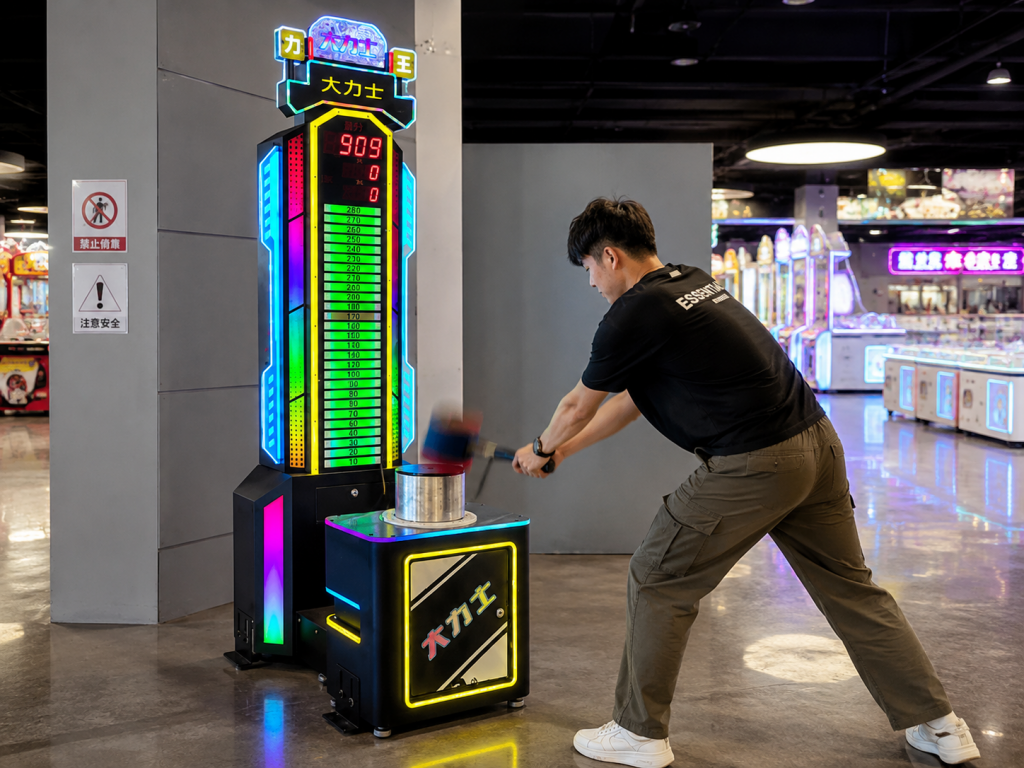
An arcade strength tester turns a simple physical action into an immediate score challenge that players and spectators can understand within seconds. Instead of relying on complicated controls or long instructions, this type of machine gives players one clear objective: make a strong attempt and see how high the result reaches. The tall scoring display also makes the outcome visible from a distance, helping the game attract attention even before someone starts playing.
Why Simple Gameplay Attracts More Players
One advantage of a strength test arcade game is its simplicity. Most customers do not need previous experience to understand what they are supposed to do. The physical interaction is familiar, while the illuminated scoring system gives immediate feedback after each attempt.
That short learning curve is useful in entertainment venues where customers move between different activities. A player can approach the machine, complete a round quickly, compare the result, and decide whether to try again.
This makes the format suitable for arcades, family entertainment centers, bowling venues, leisure centers, game lounges, shopping malls, and other commercial entertainment spaces.
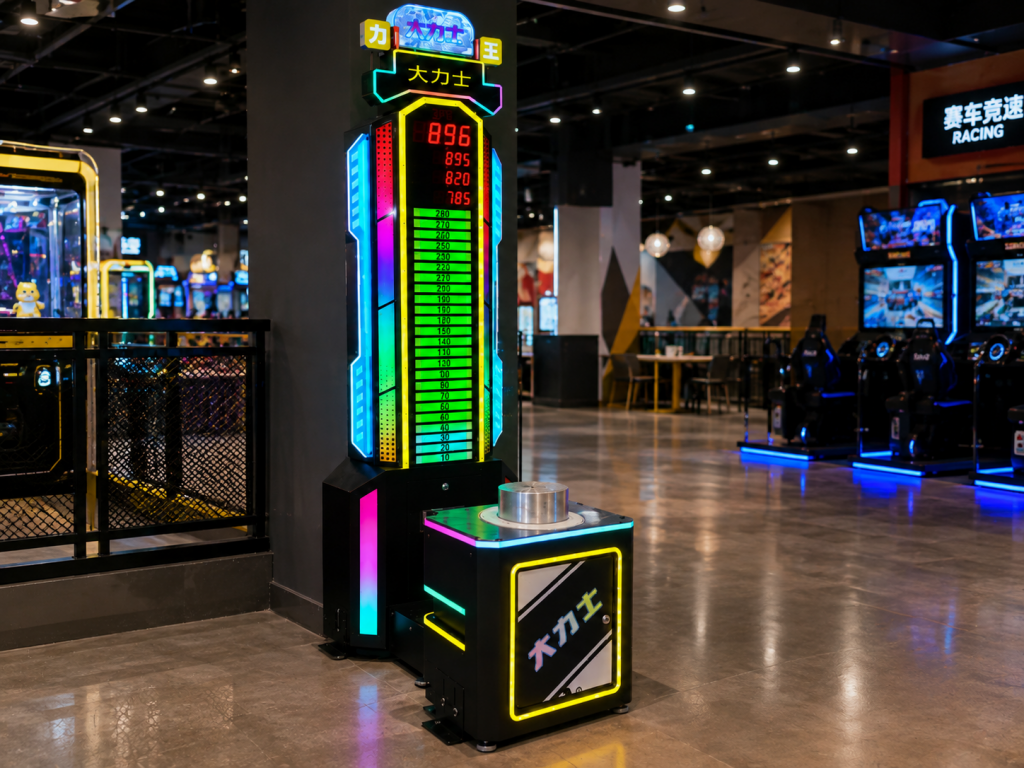
The machine also works well as a visual attraction. A tall cabinet with illuminated sections naturally creates a stronger vertical presence than many low-profile games. When positioned along a main walkway or near other competitive games, it can become an easy-to-recognize activity point.
How an Arcade Strength Tester Creates Visible Competition
A major feature of this game format is the relationship between physical action and visible scoring. Players are not simply given a result on a small screen. The tall illuminated scale makes the score movement part of the experience.
When the result rises through the display, nearby customers can immediately see whether the attempt was weak, average, or impressive. This creates anticipation during each round and makes the game more entertaining for spectators.
A Punch Strength Machine Encourages Score Comparison
A punch strength machine naturally creates competition between friends. After one person records a score, the next player already has a target to beat.
This simple comparison can generate multiple rounds without requiring complicated game modes. One customer may want to improve a personal record, while another may try to outperform someone in the same group.
The result is a short competitive cycle:
attempt, score, reaction, comparison, and another attempt.
That cycle can make a physical amusement machine feel more social than a game designed only for individual play.
A High Striker Arcade Game Can Attract Spectators
The traditional idea behind a high striker arcade game is simple: strength produces a visible result. Modern electronic versions can make that concept more suitable for indoor entertainment spaces by using digital scoring and illuminated displays.
Spectators are important because they often become the next players. Someone may first stop to watch a friend, then decide to test their own strength. A visible scoring tower makes this transition particularly natural.
For venue operators, this means the machine can create activity around itself even when only one person is actively playing.
Where to Place a Power Challenge Machine
Placement should support both visibility and safe player movement. A power challenge machine should not be squeezed tightly between cabinets if players need room to make a comfortable physical movement.
Open positions near main game areas can work well. The equipment can also be placed near entrances, waiting zones, bowling areas, billiard sections, or other spaces where groups naturally gather.
The tall display should remain visible from several directions whenever possible. Hiding the machine behind larger cabinets reduces one of its strongest advantages: the ability to attract attention through its vertical scoring display.
Operators should also consider surrounding lighting. The illuminated scoring sections should remain clear without competing with excessively bright decorative lighting nearby.
Combining a Physical Arcade Game With Other Equipment
A physical arcade game can add variety to a venue dominated by crane machines, racing games, redemption equipment, or screen-based amusement products.
Different customers prefer different forms of entertainment. Some enjoy prize collection, while others prefer reaction challenges or physical competition. Offering several game types can make the overall machine mix more balanced.
Competitive Arcade Machines Work Well in Groups
A competitive arcade machine is especially suitable for customers visiting in pairs or small groups. It gives them a quick activity that can fit between longer games.
Players do not need to commit to a long session. One round can be enough to create a memorable reaction, especially when the score is displayed clearly for everyone nearby.
This also makes the machine useful as a secondary attraction. It does not necessarily need to be the largest game in the venue to create attention.
Why Clear Scoring Matters in a Strength Challenge Game
The scoring system should be easy to read. Players should immediately understand where their result appears and how it compares with the available range.
A vertical illuminated scale can make progress feel more dramatic because the score appears to climb through multiple levels rather than simply appearing as a number.
Clear feedback also supports repeat play. If players can easily understand how close they came to a higher result, they have a stronger reason to make another attempt.
Final Thoughts
Strength-based amusement equipment succeeds because the gameplay is immediate, physical, and easy to share with other people. A visible scoring tower adds another layer by turning each attempt into a small public challenge that nearby customers can follow. For operators looking to diversify a venue with a compact but noticeable competitive attraction, an arcade strength tester can provide quick interaction, repeat attempts, and strong spectator appeal without requiring players to learn complicated rules.