
Search Intent: Why Do Buyers Search for Interactive Activate Game Room Cost?
People searching for “how much does it cost to build an interactive Activate game room” are usually planning a commercial entertainment project. They may own an arcade, family entertainment center, indoor playground, trampoline park, shopping mall venue, or a new active entertainment store.
Their real questions are not only about equipment price. They want to know the required space, game room combination, investment budget, revenue potential, ROI, supplier selection, installation factors, and whether this type of interactive game room can attract repeat customers. This guide explains the cost structure using practical room-size and equipment-price references for LED floor game, laser game, push game, hide game, arena game, hoops game, climbing game, and light flash game.
For clarity, “Activate game room” in this article refers to an interactive challenge-room business model that uses active games, sensors, LED lights, software, scoring, and physical movement. It does not imply official affiliation with any specific entertainment brand.
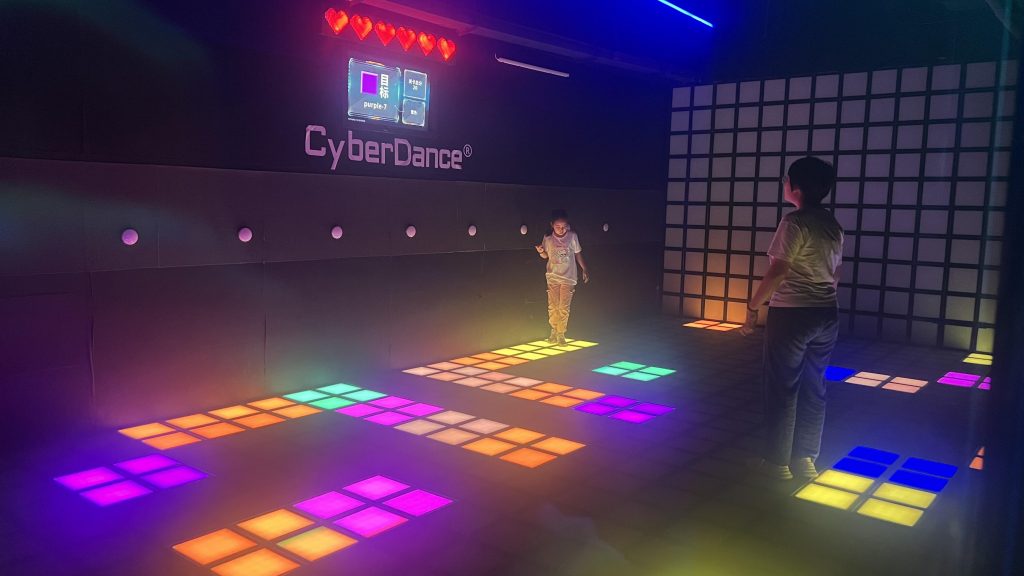
What Is an Interactive Activate Game Room?
An interactive Activate game room is a commercial entertainment space made of multiple sensor-based challenge rooms. Players complete tasks by stepping, dodging, pressing, hiding, climbing, shooting, reacting, or cooperating with teammates.
Unlike traditional arcade machines, interactive game rooms turn the whole room into the game. The walls, floors, lights, buttons, targets, sensors, and scoreboards become part of the player experience. This makes the project suitable for group entertainment, birthday parties, school trips, team building, and active family play.
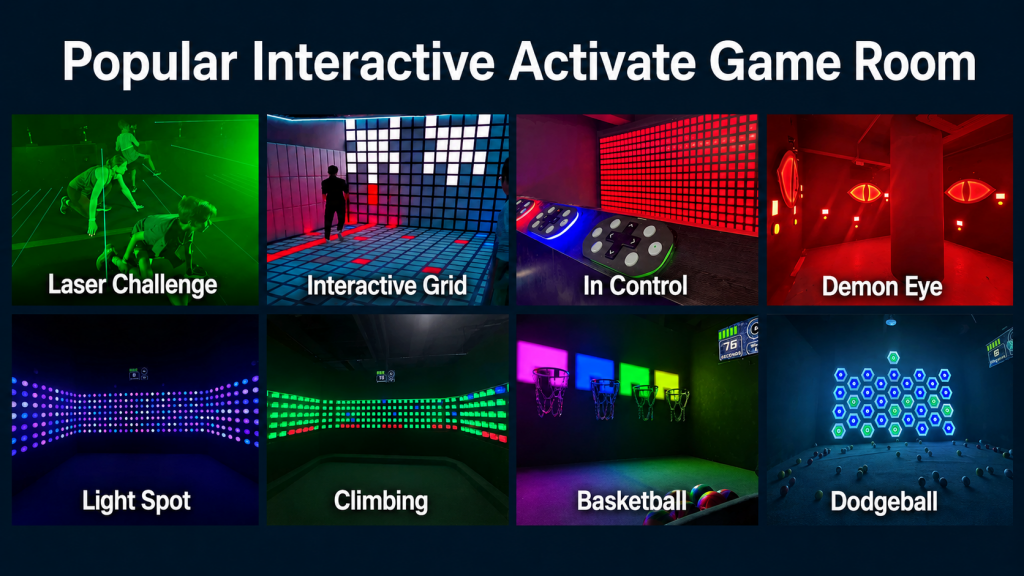
Common game rooms include LED floor game, laser game, push game, hide game, arena game, hoops game, climbing game, and light flash game. Each room can be sold as a single challenge or combined into a time-based interactive game package.
How Much Does Each Interactive Game Room Cost?
The equipment cost of an interactive game room depends on the game type, room size, sensor system, lighting, structure, software, and customization. Based on the reference data provided, a single game room can cost from about US$2,300 to US$5,000 for equipment.
The table below shows a practical price and space reference for each room:
| Game Room Type | Reference Area | Reference Equipment Cost |
|---|---|---|
| LED Floor Game | 25㎡ | US$5,000 |
| Laser Game | 25㎡ | US$4,500 |
| Push Game | 20㎡ | US$2,300 |
| Hide Game | 20㎡ | US$3,800 |
| Laser Game | 20㎡ | US$4,500 |
| Arena Game | 15㎡ | US$4,000 |
| Hoops Game | 20㎡ | US$2,800 |
| Climbing Game | 25㎡ | US$4,500 |
| Light Flash Game | 15㎡ | US$2,800 |
If all nine rooms are included, the reference equipment budget is approximately US$34,200, with a combined game-room area of about 185㎡. This is an equipment-only reference and does not include decoration, construction, shipping, taxes, installation, local labor, rent, or operating costs.
What Is the Total Budget to Build a Complete Interactive Game Room Project?
The total project budget is usually higher than the equipment cost because a commercial game room also requires room decoration, electrical work, flooring, walls, safety spacing, lighting control, signage, ventilation, staff areas, waiting zones, and installation.
A practical project budget should include:
- Interactive game equipment
- Room construction and decoration
- Electrical wiring and power supply
- Flooring, wall panels, and safety materials
- Lighting, sound, and visual design
- Shipping and import cost
- Installation and technical support
- Spare parts and maintenance tools
- Staff training and operation setup
- Marketing and opening promotion
For example, if the selected equipment cost is US$34,200, the final project cost may still vary significantly depending on the country, venue condition, contractor cost, shipping distance, and design level. Buyers should treat equipment price as the first layer of investment, not the full project cost.
How Much Space Do You Need for an Interactive Game Room?
The required space depends on how many game rooms you want to build and whether you need reception, waiting areas, storage, staff passage, and customer flow space. The game-room area alone is not the same as the total store area.
Based on the reference room sizes, a compact project can start with 55–80㎡ of game-room space, while a full multi-room challenge venue may require 185㎡ or more for game rooms alone. In real venue planning, operators should also reserve additional space for corridors, queue areas, front desk, equipment access, and safety movement.
A simple planning rule is: first calculate the total game-room area, then add extra space for customer flow and operation. This helps avoid building rooms that look good on paper but feel crowded during real gameplay.
What Are the Best Game Room Packages for Different Budgets?
Not every investor needs to build all rooms at the beginning. A smarter approach is to choose a package based on venue size, customer type, and investment stage.
| Package Type | Suggested Rooms | Game Area | Equipment Cost |
| Starter Package | Push Game + Hoops Game + Light Flash Game | 55㎡ | US$7,900 |
| Standard Package | LED Floor Game + Laser Game + Push Game + Hoops Game + Light Flash Game | 105㎡ | US$17,400 |
| Growth Package | LED Floor Game + Laser Game + Push Game + Hide Game + Arena Game + Hoops Game | 125㎡ | US$22,400 |
| Full Challenge Package | All 9 reference rooms | 185㎡ | US$34,200 |
The starter package is suitable for smaller venues or first-time investors. The standard package offers stronger variety and better visual attraction. The growth and full challenge packages are better for FECs, shopping mall projects, active entertainment stores, and venues that want to sell group packages.
Which Game Rooms Should You Choose First?
The best game combination depends on your audience. For most new projects, it is better to combine visual attraction, simple rules, physical movement, and group competition.
A balanced first-stage setup can include:
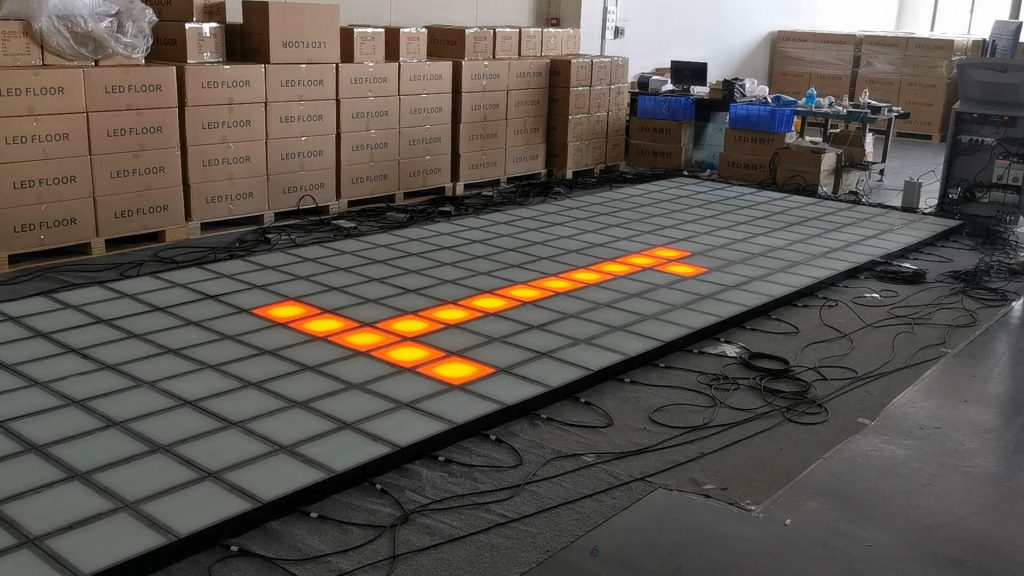
- LED Floor Game for strong visual impact and high replay value
- Laser Game for immersive challenge and social sharing
- Push Game for simple reaction-based gameplay
- Hoops Game for sports-style play
- Light Flash Game for fast reaction and compact space use
This combination covers different player actions: stepping, dodging, pressing, shooting, and reacting. It also makes the venue easier to explain to customers. A project with only one type of challenge may feel repetitive, while a mixed game lineup creates a stronger active entertainment experience.
How Do Different Interactive Game Rooms Compare?
Each game room creates a different player experience. A good interactive entertainment venue should not rely on one game only. It should combine different challenges to create movement variety and repeat value.
| Game Type | Main Player Action | Best Commercial Value |
| LED Floor Game | Step, avoid, react | Strong visual attraction and replay value |
| Laser Game | Dodge, move, complete tasks | Immersive challenge and photo-friendly experience |
| Push Game | Press buttons quickly | Low cost and easy gameplay |
| Hide Game | Hide, detect, complete missions | Team strategy and group fun |
| Arena Game | Multi-task challenge | Good for group competition |
| Hoops Game | Shoot into targets | Sports-style skill challenge |
| Climbing Game | Climb and react | Physical challenge and active play |
| Light Flash Game | React to lights | Fast turnover and compact design |
The right combination should match your brand positioning. A family venue may focus on easy-to-play games, while a youth-oriented venue may add more competitive and physically demanding rooms.
What ROI Can an Interactive Activate Game Room Generate?
ROI depends on customer traffic, ticket price, session length, group size, operating hours, rent, labor, marketing, and repeat visits. The advantage of an interactive game room is that it can be sold as a time-based experience instead of a single-machine play.
A simple revenue model may look like this:
| Factor | Example |
| Average ticket price | US$8 per player |
| Average players per session | 4 players |
| Sessions per day | 20 sessions |
| Daily gross revenue | US$640 |
| Monthly gross revenue | About US$19,200 |
This is only a sample calculation. Actual performance depends on market pricing, location, customer flow, occupancy rate, and operating strategy. For many projects, ROI improves when operators sell birthday packages, group challenges, school activities, corporate team-building events, memberships, and multi-game passes.
What Business Models Can Improve Revenue?
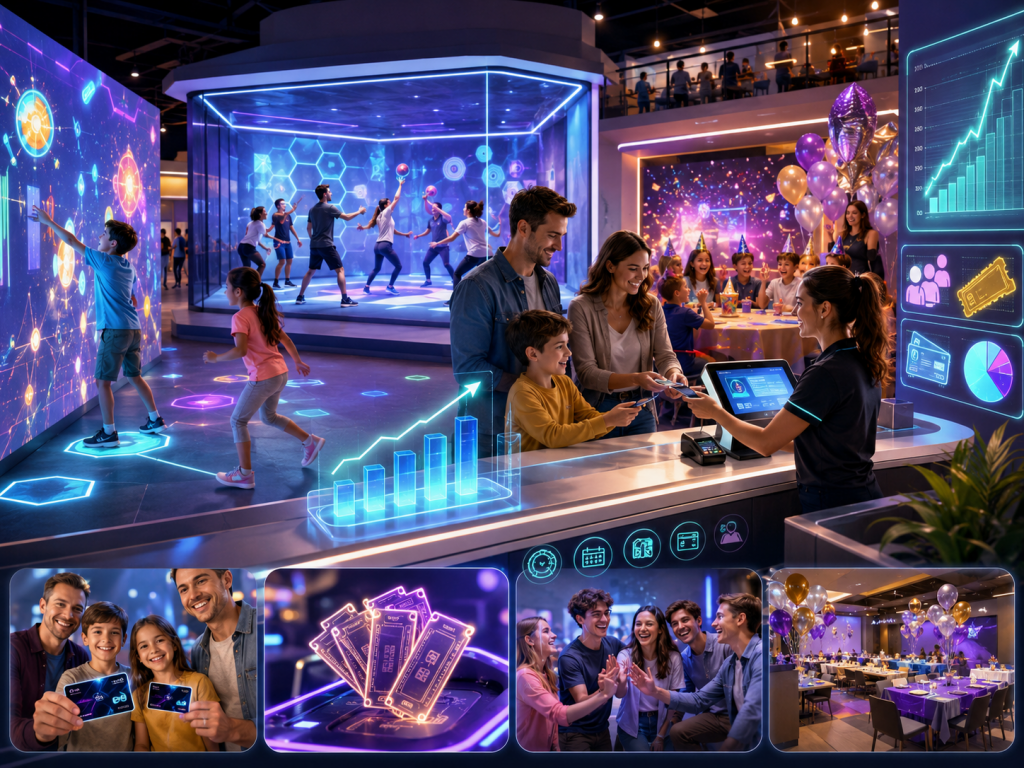
Interactive game rooms can generate revenue through more than one channel. This is one reason they are attractive for FECs, malls, and active entertainment venues.
Common revenue models include:
- Pay-per-play tickets
- Timed access passes
- Multi-room challenge packages
- Birthday party bookings
- School group activities
- Corporate team-building events
- Family membership cards
- Off-peak promotion packages
- Weekend premium pricing
- Add-on sales such as drinks, snacks, and merchandise
A strong business model should encourage repeat visits. Scoreboards, difficulty levels, team rankings, seasonal challenges, and membership rewards can help players return and try to beat their previous results.
Where Can You Build an Interactive Game Room?
Interactive game rooms are suitable for venues that want active, social, and technology-based entertainment. The best locations usually have strong foot traffic, group visitors, and enough space for safe movement.
Suitable venues include:
- Family entertainment centers
- Shopping malls
- Indoor amusement parks
- Trampoline parks
- Arcade centers
- Sports entertainment centers
- Tourist attractions
- School activity centers
- Team-building venues
- Franchise entertainment stores
Shopping malls are good for visibility and impulse traffic. FECs are good for families and birthday bookings. Trampoline parks and sports centers are good for active play. Team-building venues are suitable for group packages and weekday bookings.
What Extra Costs Should Buyers Consider Before Building?
Many buyers only compare equipment prices, but a successful project requires a full cost view. Extra costs can affect the final investment and ROI.
Important cost items include:
- Site rent or revenue share
- Local construction and decoration
- Electrical and network work
- Air conditioning and ventilation
- Wall protection and safety flooring
- Fire safety and local compliance
- Shipping and customs fees
- Installation cost
- Spare parts
- Staff salary
- Cleaning and maintenance
- Marketing and launch promotion
Before ordering equipment, investors should confirm venue drawings, power conditions, ceiling height, wall structure, customer flow, and local construction requirements. This helps suppliers recommend a more accurate equipment combination and layout plan.
How Should You Choose an Interactive Game Room Supplier?
Choosing the right supplier is critical because an interactive game room is not a single machine purchase. It is a project involving equipment, software, layout, installation, safety, and operation.
Buyers should evaluate:
- Does the supplier understand commercial entertainment projects?
- Can they provide multiple interactive game rooms?
- Can they support layout planning?
- Are room sizes customizable?
- Is the software stable and easy to operate?
- Are spare parts available?
- Can the supplier provide installation guidance?
- Can the games support group play and different difficulty levels?
- Does the supplier offer long-term technical support?
A reliable supplier should help you match equipment with your venue, not only send a price list. For B2B buyers, project planning ability is often more valuable than the lowest product price.
What Does a Successful Interactive Game Room Project Look Like?
A successful interactive game room project usually has a clear theme, balanced game combination, good customer flow, and a business model designed around repeat play.
For example, a 100–125㎡ game-room area can combine LED Floor Game, Laser Game, Push Game, Hoops Game, Light Flash Game, and Arena Game. This gives customers multiple challenges in one visit and allows operators to sell timed access or multi-room packages.
The project should also include clear signage, simple rules, visible scoreboards, safe movement space, and photo-friendly lighting. When customers understand the rules quickly and enjoy competing with friends, the room has a stronger chance of generating repeat visits.
Why Work with BLEE for Interactive Game Room Projects?
BLEE provides commercial amusement equipment and one-stop arcade solutions for global entertainment venues. For interactive game room projects, BLEE can help buyers evaluate space, choose game combinations, plan layouts, and match equipment to budget and audience.
BLEE’s interactive game solutions can include LED floor game, laser game, push game, hide game, arena game, hoops game, climbing game, light flash game, and other active entertainment equipment. This allows investors to build a complete interactive challenge zone rather than purchasing isolated products.
For project customers, the main value is practical planning. BLEE can support equipment selection, game combination, layout suggestion, customization, and project communication according to venue size and business goals.
FAQ About Interactive Activate Game Room Cost
How much does it cost to build an interactive Activate game room?
Based on the reference equipment prices, a single room may cost from about US$2,300 to US$5,000. A full 9-room interactive game lineup may cost around US$34,200 for equipment, excluding construction, shipping, installation, taxes, and local operating costs.
How much space is needed for an interactive game room?
The reference room sizes range from 15㎡ to 25㎡ per game room. A starter setup may need about 55㎡ of game-room space, while a full 9-room package may need about 185㎡ before adding corridors, reception, storage, and waiting areas.
Which interactive game room is the most cost-effective?
Push Game and Light Flash Game have lower reference equipment costs, while LED Floor Game and Laser Game offer stronger visual attraction. The best value depends on your venue size, customer type, and business model.
Can I start with only a few game rooms?
Yes. Many investors can start with 3–5 rooms, such as Push Game, Hoops Game, Light Flash Game, LED Floor Game, and Laser Game. More rooms can be added later if the venue has enough space.
What costs are not included in the equipment price?
Equipment price usually does not include decoration, construction, shipping, customs fees, installation, local labor, rent, staff salary, marketing, maintenance, and local compliance costs.
How can an interactive game room generate revenue?
Revenue can come from pay-per-play tickets, timed passes, multi-room packages, birthday parties, school activities, corporate team-building events, memberships, and add-on sales.
Is an interactive game room suitable for a family entertainment center?
Yes. Interactive game rooms are suitable for FECs because they support group play, family participation, active movement, and repeat challenges.
Can BLEE customize the game room layout?
Yes. BLEE can help customize the layout according to venue size, game selection, customer flow, budget, and project goals.
Conclusion
The cost to build an interactive Activate game room depends on the number of rooms, game types, room size, equipment configuration, and project buildout requirements. Based on the reference prices, individual game rooms range from about US$2,300 to US$5,000, while a complete 9-room equipment package is around US$34,200 with about 185㎡ of game-room area.
For investors, the best approach is not always to buy every game at once. A starter or standard package can reduce initial investment, test market response, and leave room for future expansion.
If you are planning an interactive game room, BLEE can help you choose the right game combination, estimate the equipment budget, and create a practical layout solution for your commercial entertainment project.