
Choosing the right claw machine supplier is an important step when opening an arcade, upgrading a family entertainment center, or purchasing amusement equipment for resale. An attractive cabinet may catch attention, but long-term performance depends on component quality, operating stability, maintenance access, payment compatibility, spare parts, and technical support.
A reliable business partner should provide more than a product quotation. Buyers also need help selecting suitable models, confirming electrical requirements, matching machines with prize types, arranging customization, preparing export packaging, and solving technical problems after delivery.
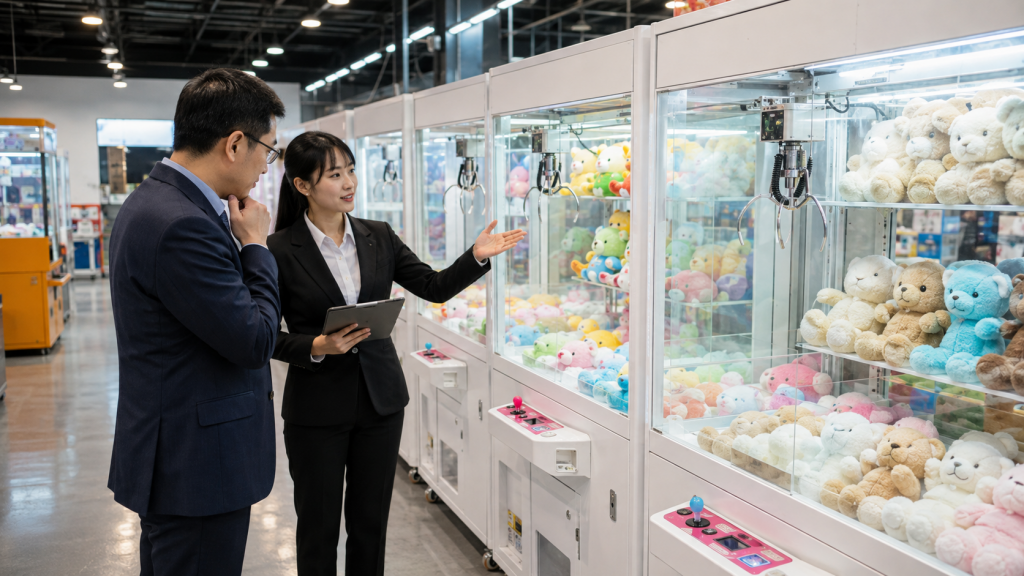
Why Equipment Quality Matters to Arcade Operators
Commercial claw machines may operate for many hours each day. Players repeatedly use the joystick, buttons, payment device, claw mechanism, and prize outlet. Small problems with these parts can stop the machine from working and reduce the revenue generated by the available floor space.
Cabinet design also affects daily operation. Staff need convenient access for prize refilling, cleaning, setting adjustments, and repairs. Machines with organized wiring, accessible service doors, and replaceable components are usually easier to maintain.
Buyers should therefore compare complete operating value rather than choosing equipment only because it has the lowest initial price.
How to Evaluate a Claw Machine Manufacturer
Before purchasing, confirm whether the seller is a direct claw machine manufacturer, a distributor, or a trading company. The company’s role may affect production control, customization, pricing, and technical communication.
A direct manufacturer should be able to explain how the machines are assembled, wired, tested, cleaned, and packed. Buyers can request factory photographs, production videos, quality inspection records, operating manuals, and previous shipment references.
Useful questions include:
- Which processes are completed inside the factory?
- How are payment devices and game functions tested?
- Can the machine be tested with the buyer’s intended prizes?
- Are inspection photos or videos available before shipment?
- Which replacement parts are kept in stock?
Transparent production information makes it easier to evaluate whether the company can complete orders consistently.
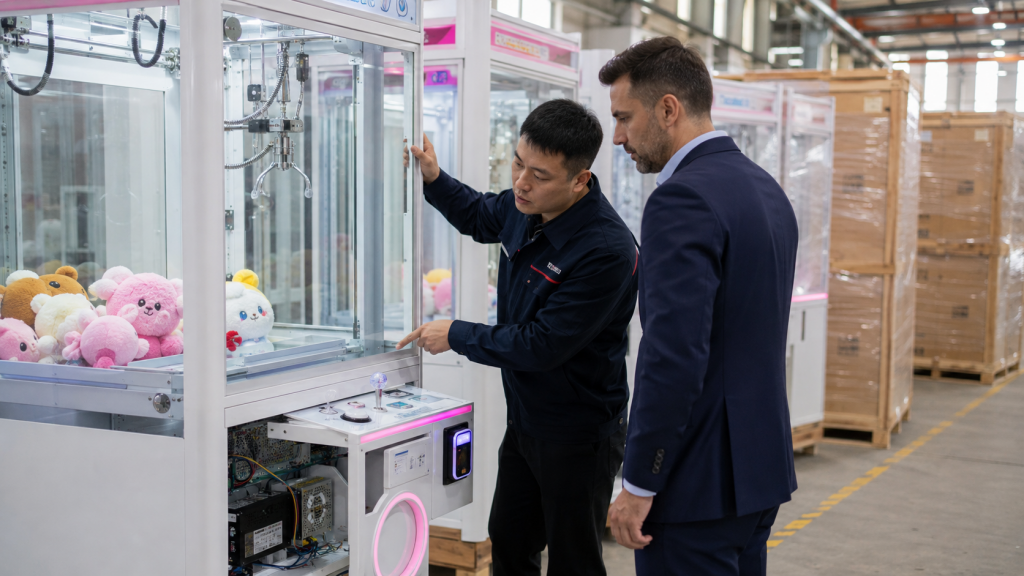
What to Check in a Claw Machine Factory
A professional claw machine factory should have clear procedures for assembly, electrical installation, testing, inspection, and packaging. Workshop size alone does not prove quality. Production organization and final testing are equally important.
The cabinet should be stable, easy to clean, and convenient to service. Transparent panels should provide a clear view of the prizes from the front and sides. Locks, doors, and internal panels should allow operators to refill prizes and complete maintenance safely.
The claw assembly should move smoothly across the playing area. Its size, gripping strength, motor, cable, and movement range should match the intended prize type.
Other important components include:
- Mainboard and power supply
- Internal wiring
- Joystick and control buttons
- Coin acceptor or card reader
- Sensors and motors
- LED lighting
- Digital display
- Prize outlet
- Service doors and locks
Specifications should be confirmed in writing before production, especially for customized or bulk orders.
How to Evaluate a Claw Machine Supplier
Buyers should compare suppliers based on product range, communication, testing, customization, warranty, and export experience. A strong partner should recommend suitable equipment based on the venue rather than promoting only one model.
Important information to confirm includes:
- Available cabinet sizes
- Player capacity
- Suitable prize types
- Standard and optional components
- Payment-system options
- Voltage and plug standards
- Minimum order quantity
- Production lead time
- Warranty coverage
- Spare-parts availability
Clear answers help buyers compare offers and avoid unexpected costs later.
Compare Models from an Arcade Claw Machine Supplier
An experienced arcade claw machine supplier should offer several cabinet styles for different commercial environments.
Common models include:
- Single-player claw machines
- Two-player claw machines
- Four-player claw machines
- Mini claw machines
- Premium claw machines
- Island claw machines
- Large-prize claw machines
- Clip prize machines
- Scissors prize machines
- Customized themed machines
Mini machines are suitable for restaurants, small stores, children’s areas, and locations with limited space. Standard single-player cabinets are flexible and can be installed in many venues.
Two-player and four-player machines allow more customers to play within one cabinet structure. Island machines are usually placed in open central areas where players can approach from several directions.
The selected model should match the available floor space, target customers, expected traffic, prize size, payment method, and operating budget.
Plan Customization Before Production
Customization can help arcade chains, distributors, shopping mall projects, and themed venues create a consistent visual identity.
Common options include:
- Company logos
- Cabinet stickers
- Exterior colors
- Character graphics
- Illuminated signs
- LED lighting effects
- Payment devices
- Voltage and plug standards
- Game parameters
- Prize-area layouts
Before production begins, request a clear design draft. Confirm the logo position, cabinet colors, printed graphics, control-panel layout, and payment devices.
Buyers should also ask whether stickers and illuminated signs can be replaced later. Replaceable graphics make it easier to update branding or promotional themes without changing the complete cabinet.
Confirm Payment and Electrical Compatibility
Payment requirements vary between countries and venues. Some operators use coins or tokens, while others use bill acceptors, card readers, QR payment, or centralized arcade systems.
Confirm which payment device is included with the machine and which options require additional customization.
Buyers should check:
- Accepted coin or token size
- Bill acceptor compatibility
- Card reader installation space
- QR payment compatibility
- Credit and price settings
- Local voltage
- Electrical frequency
- Plug type
The seller should also explain how operators can adjust the game price. Do not assume that every payment system shown in promotional images is included in the quotation.
Match the Machine with the Intended Prizes
Different prizes require different claw sizes, gripping strengths, cabinet layouts, and operating settings. A machine designed for small plush toys may not work well with large gifts, heavy products, keychains, capsules, or packaged prizes.
Provide the crane game machine manufacturer with information about the intended prizes, including their size, weight, shape, material, packaging, and retail value.
Common adjustable settings include:
- Claw strength
- Game duration
- Movement speed
- Credit cost
- Payout frequency
- Sound volume
- Lighting effects
- Winning mode
When possible, provide sample prizes or detailed measurements before production. Testing with similar products helps confirm that the claw mechanism and cabinet layout are suitable.
Review Support from a Prize Machine Supplier
After-sales service is important because even a well-built commercial machine may eventually require adjustments or replacement parts.
Before ordering, confirm:
- Warranty duration
- Warranty coverage
- Included spare parts
- Replacement-part availability
- Remote troubleshooting methods
- Operating instructions
- Maintenance videos
- Wiring diagrams
- Technical response time
A professional prize machine supplier should be able to provide support through photographs, videos, messages, or video calls.
International buyers should also consider ordering common spare parts with the machines. Useful items may include buttons, joysticks, claws, motors, sensors, locks, payment components, power supplies, and mainboard parts.
Review Export Packaging and Total Purchase Cost
Minimum order quantity, customization charges, production time, packaging, and freight can significantly affect the final investment.
Request clear information about:
- Minimum order quantity
- Sample-order availability
- Production lead time
- Customization costs
- Packaging method
- Packed dimensions
- Gross weight
- Shipping options
- Export documents
- Loading arrangements
Machines should be packed to reduce scratching, movement, moisture exposure, and impact during transportation. Packaging may include foam, reinforced cartons, stretch film, corner protection, or wooden cases.
Buyers should also confirm whether the machines are shipped fully assembled or partially disassembled and whether installation is required after delivery.
Questions to Ask Before Confirming an Order
Before selecting a business partner, ask the following questions:
- Do you manufacture the machines directly?
- Which model suits my venue and prize type?
- Which components are included in the quotation?
- Which payment systems are available?
- Can the cabinet design be customized?
- Which voltage and plug options are available?
- What is the minimum order quantity?
- How long will production take?
- How are the machines tested?
- How are they packed for export?
- Which spare parts are included?
- What warranty and technical support are provided?
Clear answers make it easier to compare companies and reduce purchasing risks.
Choose a Partner That Supports Long-Term Operation
Selecting a reliable claw machine supplier requires more than comparing product photos and prices. Buyers should evaluate production experience, cabinet quality, prize compatibility, customization, payment systems, warranty, packaging, spare parts, and technical service.
A suitable partner should understand both the equipment and the commercial environment in which it will operate. Clear communication before production can reduce risk and help the machines perform more reliably after installation.
BLEE provides commercial arcade machines, customized cabinet designs, payment options, and international project support for different venue requirements.