
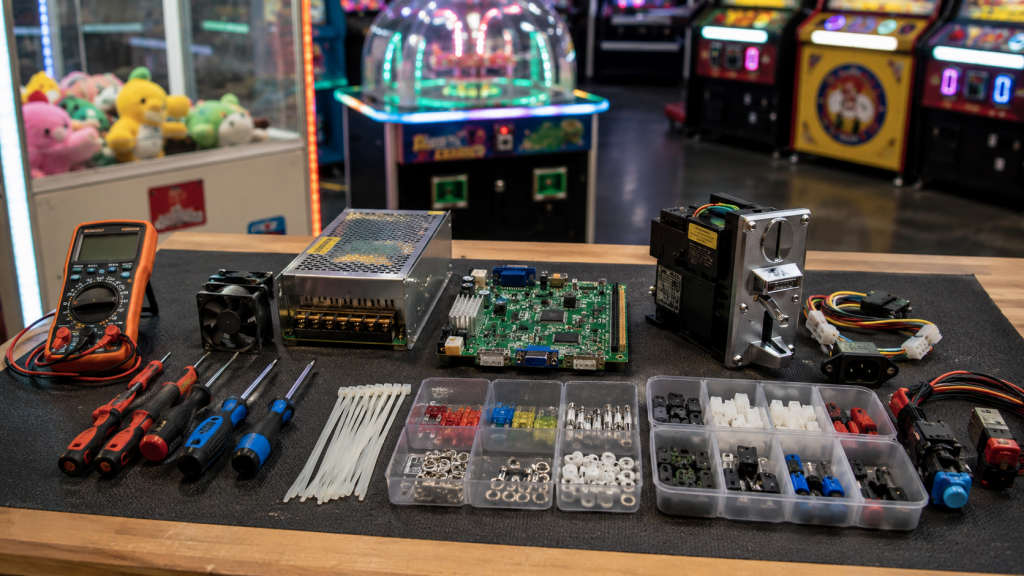
An arcade spare parts kit is essential for reducing equipment downtime in a mixed entertainment venue. A game center may operate claw machines, redemption games, boxing machines, basketball machines, racing simulators, kiddie rides, and other commercial amusement equipment. Although these products use different systems, many rely on similar payment devices, buttons, sensors, power supplies, locks, wiring parts, and lighting components.
Why Mixed Venues Need Arcade Replacement Parts
Different products may use unique mainboards, motors, ticket systems, display interfaces, or payment devices. A small failure can leave a valuable machine unavailable while staff wait for the correct component.
Local arcade replacement parts help operators complete simple repairs quickly and reduce the risk of ordering the wrong item. They also improve communication with technical support because the part number, connector type, voltage, and compatible model are already recorded.
Organize Game Machine Spare Parts by System
Parts should be grouped by operating system rather than only by product name. This makes it easier to identify components that can be shared across several machines.
Payment and control parts include coin acceptors, card reader interfaces, joysticks, push buttons, microswitches, steering sensors, and pedal switches. Power parts include power supplies, transformers, fuses, cooling fans, and terminal blocks.
Motion parts may include motors, motor drivers, belts, bearings, position sensors, and limit switches. Prize and ticket parts include claw coils, claw cables, ticket dispensers, prize outlet sensors, counters, and capsule release mechanisms. Lighting and audio parts include LED strips, speakers, light controllers, and display backlights.
How to Build an Arcade Spare Parts Kit
Each component should be classified according to how strongly it affects machine operation.
Level A contains critical downtime parts. The machine normally cannot operate without them. Examples include mainboards, power supplies, payment devices, ticket dispensers, motor drivers, and essential sensors.
Level B contains player-experience parts. The machine may still operate, but the game becomes less attractive or harder to use. Examples include joysticks, buttons, speakers, LED modules, and small displays.
Level C contains appearance and low-frequency items, such as cabinet stickers, decorative panels, brackets, spare screws, and cosmetic trim. These items are useful, but they do not require the same stock priority as operational components.
Recommended Amusement Machine Parts by Category
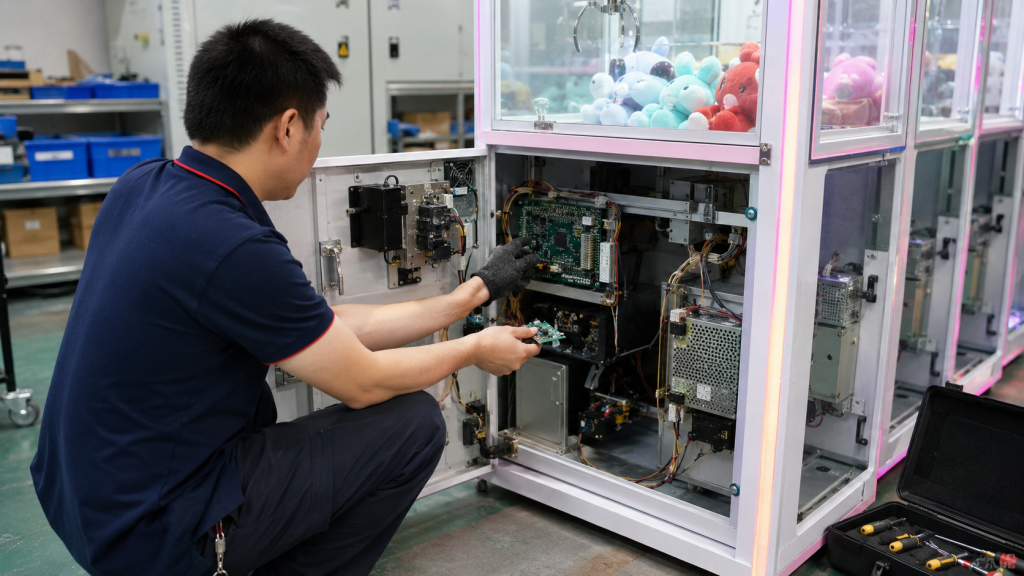
Claw and prize machines may require claw coils, cables, trolley motors, joysticks, play buttons, prize outlet sensors, power supplies, mainboards, locks, LED strips, and payment devices.
Racing, shooting, basketball, and boxing machines receive frequent physical use. Useful amusement machine parts may include steering sensors, pedal switches, trigger buttons, sports sensors, cooling fans, display cables, speakers, and control boards.
Redemption equipment often depends on ticket dispensers, ticket sensors, counters, motors, belts, power supplies, and card reader interfaces. Kiddie rides may require start buttons, relays, timers, motion switches, motor controllers, fuses, and emergency-stop components.
Every replacement should match the original voltage, connector type, dimensions, and technical specification. Similar-looking parts are not always interchangeable.
Create an Arcade Maintenance Parts Record
Each machine should have a technical record containing its model number, serial number, voltage, plug type, mainboard model, power supply model, payment device, motor specifications, compatible parts, warranty period, and supplier contact.
Photographs of the mainboard, power supply, connectors, and payment system should also be stored in a shared folder.
Repair records should include the fault date, symptom, diagnosis, replaced component, and final test result. Repeated failures may indicate overheating, incorrect voltage, poor ventilation, loose wiring, or mechanical resistance.
Assemble a Practical Arcade Service Kit
An arcade service kit should contain diagnostic tools and commonly used replacements. Useful tools include a multimeter, screwdriver set, hex keys, wire stripper, crimping tool, electrical tape, cable ties, spare connectors, fuses, labels, and cleaning materials.
Common replacements may include buttons, microswitches, power switches, locks, sensors, LED modules, coin acceptor parts, and selected power supplies. The exact contents should reflect the machine mix at the venue.
International buyers should discuss spare components before the machines leave the factory. Adding small parts to the initial shipment is often easier and less expensive than arranging separate delivery later. Ask the supplier to label every item and identify its compatible model.
Set Minimum Stock and Reorder Levels
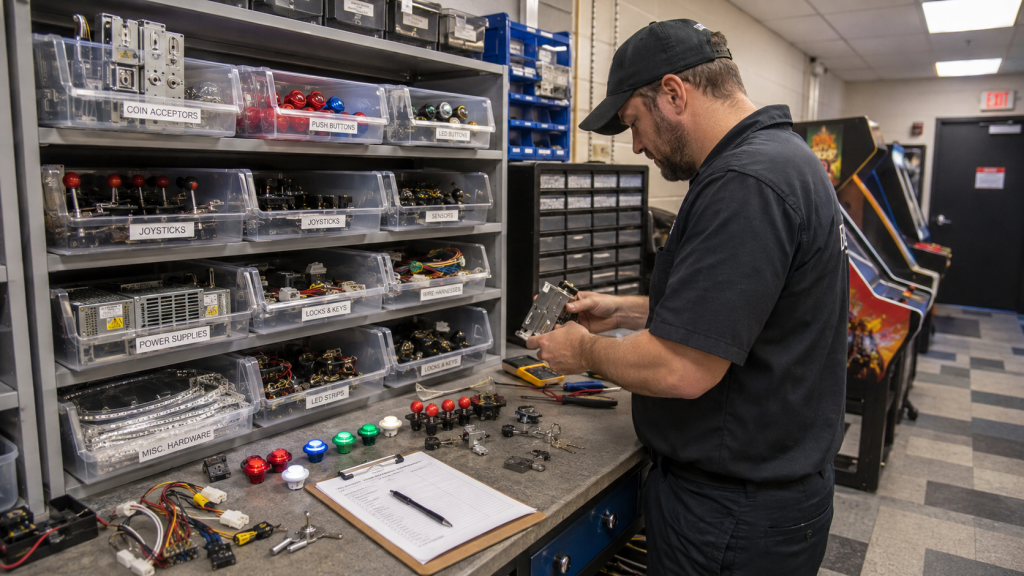
Stock levels should depend on the number of compatible machines, failure frequency, supplier delivery time, part cost, and operational importance.
A common button used across many machines deserves a higher stock level than a decorative panel used on one cabinet. A specialized mainboard may be expensive, but keeping one spare can be reasonable if replacement delivery takes several weeks.
Every item should have an internal SKU, compatible models, storage location, current quantity, and minimum stock level. Critical items can be checked monthly and the complete inventory reviewed quarterly.
Turn Parts Inventory into a Downtime Prevention System
A well-planned arcade spare parts kit should connect equipment purchasing, preventive maintenance, staff training, repair records, and supplier support. Operators should standardize common components where possible, identify critical model-specific items, and update stock levels according to actual repair history.
BLEE can provide commercial amusement equipment, recommended spare-parts packages, technical documents, and replacement components for mixed entertainment projects. Buyers should confirm compatible part numbers, maintenance materials, and model-specific requirements when placing an equipment order.